Alamat
Malaysia

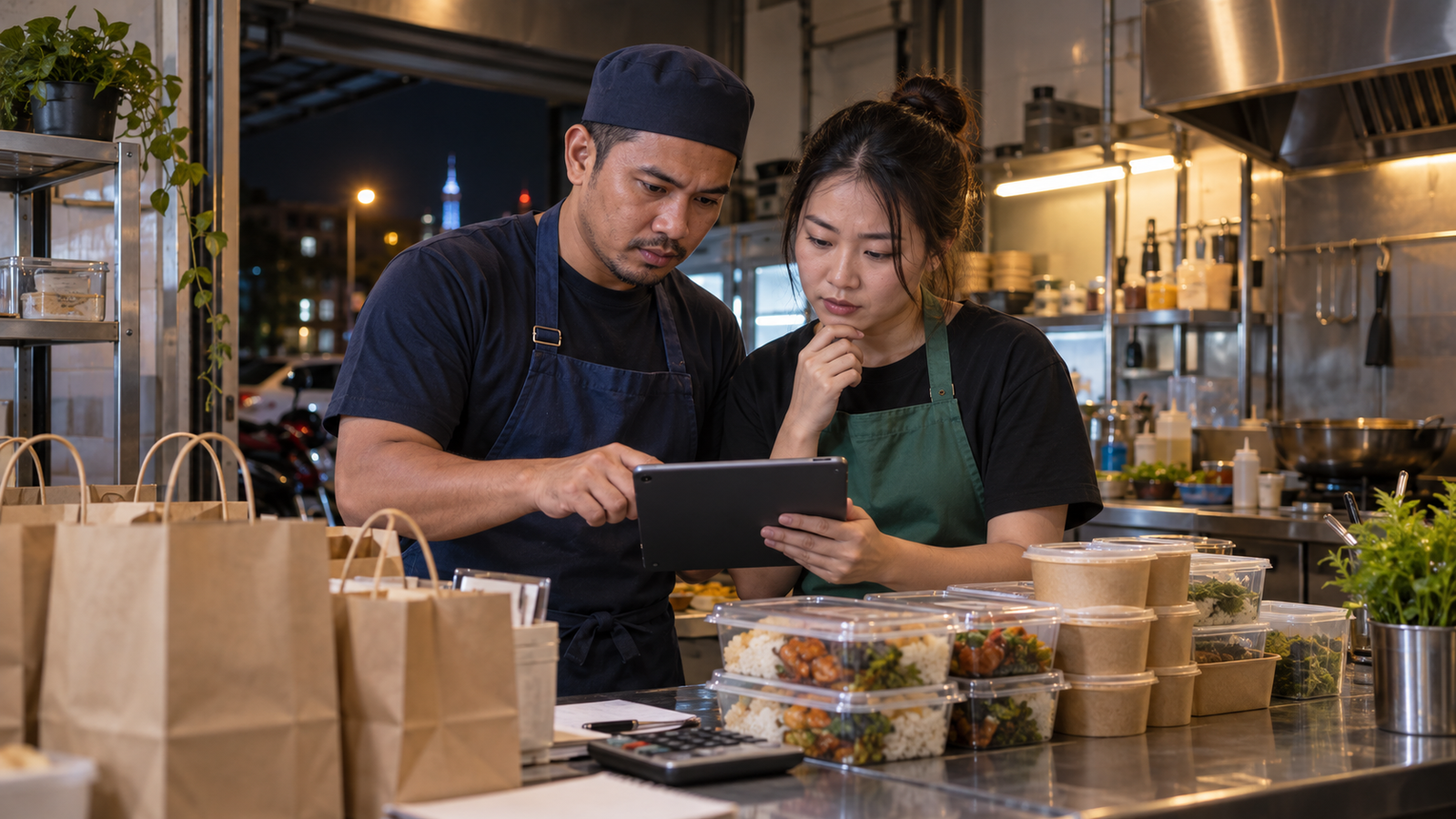

Aiman and Jia Wei run a small takeaway kitchen in Kuala Lumpur. Every evening, their tablet keeps ringing with new delivery orders. The kitchen looks busy, the order count keeps rising, and total sales appear encouraging.
Yet their bank balance does not grow as quickly as expected. They realise that the price shown to the customer is not the amount their business keeps.
An RM18 order does not mean RM18 in revenue
One of their popular rice meals sells for RM18 on a delivery platform. They record every deduction and cost connected to the order:
- Platform commission and service charges: RM4.50
- Customer promotion funded by the restaurant: RM1.50
- Food ingredients: RM5.20
- Container, cutlery and paper bag: RM1.30
- Kitchen labour and utilities: RM2.20
After RM14.70 in deductions and costs, only RM3.30 remains. A walk-in customer buying the same meal may leave a larger margin because there is no platform commission and simpler packaging can be used.
Record each sales channel separately
Aiman previously combined cash, bank transfers and delivery-platform sales into one daily total. That made it impossible to see which channel produced the best result.
Now they record the number of orders, gross sales, discounts, commissions and packaging costs for each channel. A busy channel is no longer judged by order volume alone. They compare the money left after direct costs.
Promotions need a clear limit
Discounts can attract new customers, but repeated promotions can quietly reduce profit. Jia Wei checks who funds each campaign before accepting it. If the kitchen pays part of the discount, that amount is included in the cost of the order.
They also avoid running several discounts at the same time. Every promotion has a start date, an end date and a target, such as attracting first-time buyers or increasing orders during a quiet period.
Packaging is part of the product cost
A container that costs only a few ringgit may look small, but the amount becomes significant across hundreds of orders. Sauces, labels, paper bags and disposable cutlery must also be counted.
By recording packaging use, the partners can choose suitable materials, reduce waste and price delivery meals more accurately without lowering quality.
Try this for seven days
Separate your walk-in, direct-order and delivery-platform sales for seven days. For each channel, record gross sales, fees, discounts, ingredients, packaging and labour. Compare the profit left per order instead of comparing sales totals alone.
Know which sales channel truly supports your business
KiraLaris helps you record sales and costs clearly so every busy day can lead to a better decision.